

EYFS
The Early Years Foundation Stage (EYFS) applies to children from birth to the end of their first year school. At Cedars Park Primary School children join our EYFS in the academic year they turn five. Children join us from many different nurseries and pre-schools or straight from home. Our EYFS has two classes: Kittiwakes Class and Woodpeckers Class. Each class is led by a qualified teacher and supported by a teaching assistants.
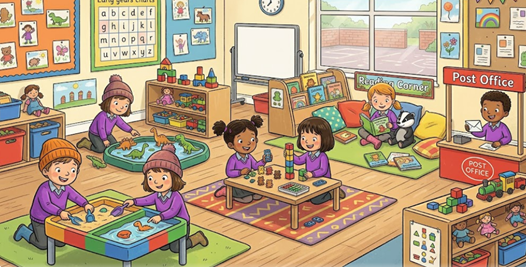
Our aims for the Early Years Foundation Stage at Cedars Park Primary School are that children:
- are happy;
- develop a love of learning;
- develop positive attitudes to learning and skills that will help them achieve in later life;
- access a broad and balanced curriculum that gives them a solid grounding in the wide-ranging knowledge and skills they need for good progress through school and life;
- become active members of the school community, where there is no limit to learning.
What are we trying achieve?
Our Early Years setting follows the curriculum outlined in the 2021 EYFS Statutory Framework. We use Development Matters (non-statutory guidance from July 2021) to plan objectives that lead children to the Early Learning Goals.
The EYFS framework includes 7 areas of learning and development that are equally important and inter-connected. 3 areas – known as the prime areas – are particularly important for igniting curiosity and enthusiasm for learning, and for building children’s capacity to learn, form relationships and thrive.
The Prime Areas are:
- Communication and language
- Physical development
- Personal, social and emotional development
The Prime areas are strengthened and applied through four Specific Areas:
- Literacy
- Mathematics
- Understanding the world
- Expressive arts and design
These seven areas are a basis for planning teaching, the environment and the experiences that we offer our EYFS children at Cedars Park.
How do we organise learning?
For each of the seven areas we have developed a long-term plan of the skills which children will learn each term. Each half term our learning is based on a theme.
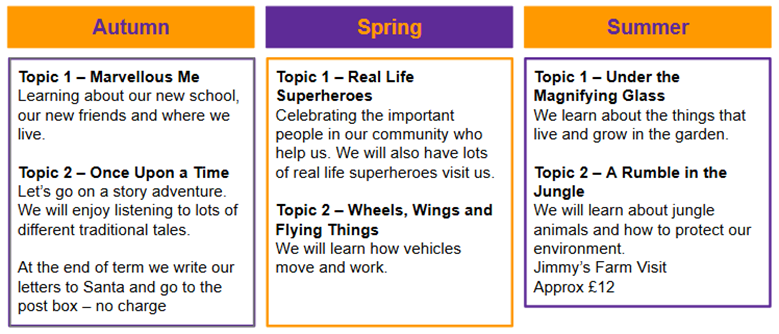
For this a medium-term plan is produced which outlines the focuses for the half term for the seven areas of learning. These focuses may change during the half term to reflect the children’s interests or needs.
Each week a weekly plan is shared with all staff so they know the expectations for that week, how they can move children’s learning on and what knowledge we would like our children to have by the end of that week.

Twinkl Phonics is used to deliver daily phonics teaching to ensure consistency with the rest of the school. Phonics is taught daily by the class teacher. The children join Kit and Sam on adventures around familiar settings and on the way they learn to read new sounds and tricky words. Children will be given a reading book in the first few weeks of term and their books will match the sounds they are being taught in school.

Maths lessons are guided by the NECTMs Mastering Number and supplemented by White Rose Hub. to ensure consistency with the rest of the school. Maths is taught five times a week.
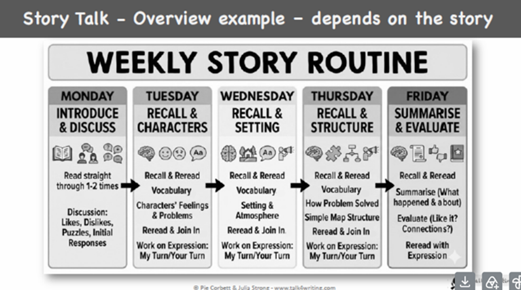
Literacy is based around a high-quality book which engages children and inspires further learning. We use elements of Pie Corbett’s Talk for Reading to support this. Literacy sessions focus on developing communication and writing skills.
Every afternoon begins with whole-class teaching which may focus on Personal, Social and Emotional Development (using Jigsaw – our whole school approach to teaching PSHE), The World or Expressive Arts and Design. The focus links to our story or theme of the week. All children join in with the whole-class input. Some may then go and work with a teaching assistant.
We value play and believe it is fundamental to good quality learning for children within EYFS. Our children have lots of opportunities for ‘Choose Our Own Learning (COOL) Time’ where they are independent learners. Each area of learning and development is implemented through planned, purposeful play, and through a mix of adult-led and child-initiated activities. These activities and areas offer challenge but also enable children to learn without an adult being present – they act as the ‘Third Teacher’
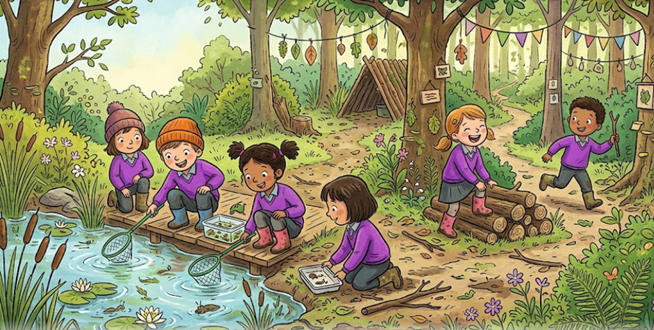
Throughout the day children are able to access outdoor learning either in the Early Years Learning Garden or in the school's Wildlife Area for 'Welly Wednesday'. When learning outside there are lots of opportunities for children to develop their own learning and follow their own interests.
Where an adult is working with a child they respond to each child’s needs and interests, guiding their development through warm, positive interaction. Where there maybe gaps or inconsistencies in learning the adult will give children a next step and help them to move their learning on.
How well are we achieving our aims?
Daily Assessment
Children are informally assessed throughout each day. Staff observe the children and where they may be gaps in learning these are identified and shared with the team. The team respond straight away – this may be in the moment by helping the child within their play, revisited again at a different point, or through the phonics and maths jobs the children complete with an adult each week.
Phonics Assessment
Before moving onto teaching a new set of sounds, children are assessed for phonics – their sound knowledge, their ability to read and spell words (both decodable and tricky). Children read one to one each week with either their class teacher or their teaching assistant. This is to ensure they are reading at the correct level in line with their phonic knowledge. Each child takes home a Rhino Reader from the Twinkl Phonics Program.
Formal Assessment
Within the first 6 weeks of a child joining the EYFS, staff will administer the statutory Reception Baseline Assessment (RBA).
At the end of the EYFS, staff complete the statutory EYFS Profile for each child. Children are assessed against the 17 Early Learning Goals (ELGs) to work out whether they are meeting expected levels of development (‘expected’) or are not yet reaching expected levels (‘emerging’). This information is shared with families via an end of year report and Year One teachers.
The 17 Early Learning Goals are:
Communication and Language
- Listening, Attention and Understanding
- Speaking
Personal, Social and Emotional Development
- Self-Regulation
- Managing Self
- Building Relationships
Physical Development
- Gross Motor Skills
- Fine Motor Skills
Literacy
- Comprehension
- Word Reading
- Writing
Mathematics
- Number
- Numerical Patterns
Understanding the World
- Past and Present
- People Culture and Communities
- The Natural World
Expressive Arts and Design
- Creating with Materials
- Being Imaginative and Expressive
Working with Families
We recognise the importance of working closely with our families. Each child has their own Learning Journey which is on Tapestry. Families receive updates on Tapestry, keeping them informed with key learning for that week, as well as sharing children's ‘Magic Moments’.
Twice a year, families are invited in to meet with their child’s teacher. At the end of the year each family receives a formal report about their child’s year in EYFS.